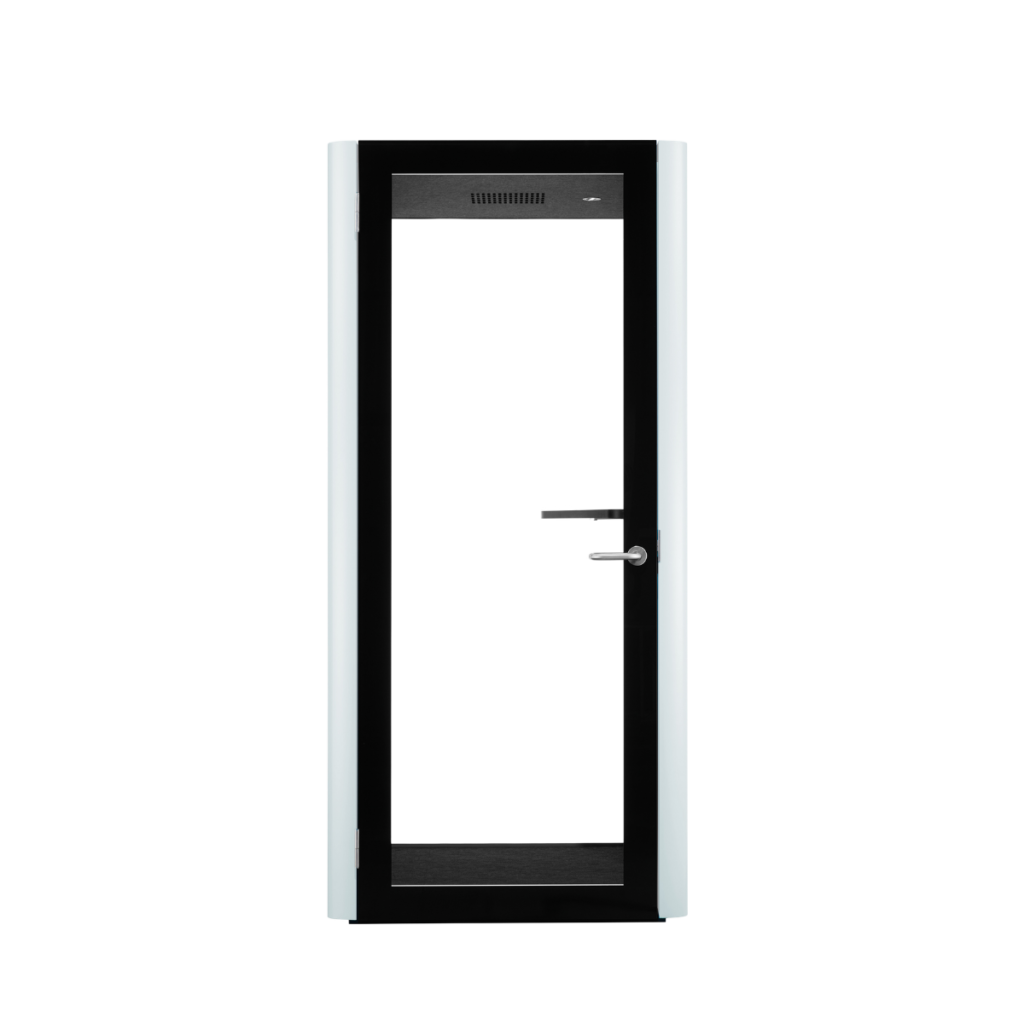

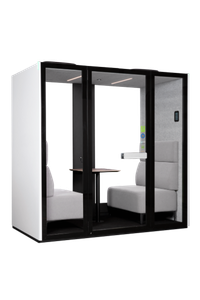
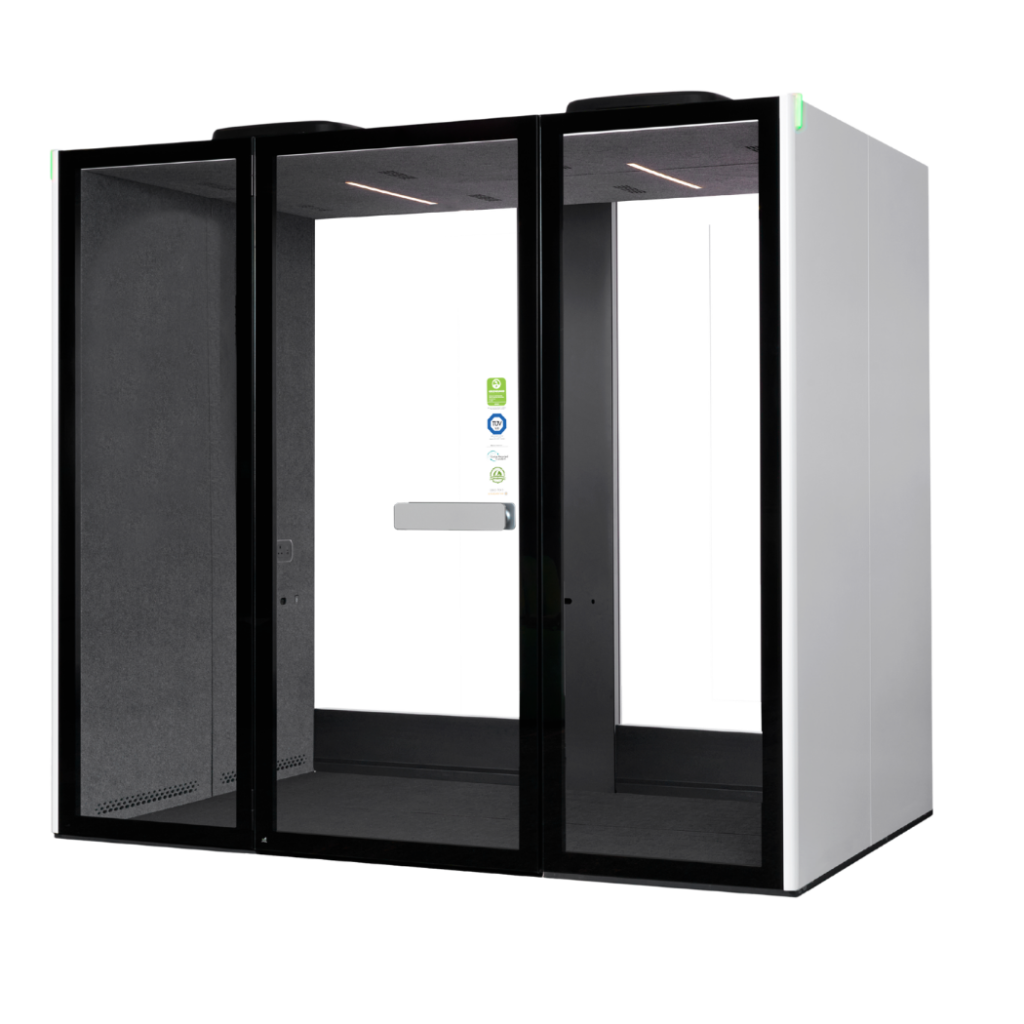
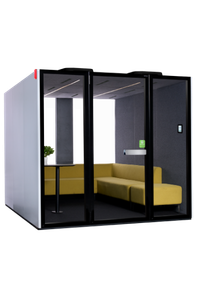
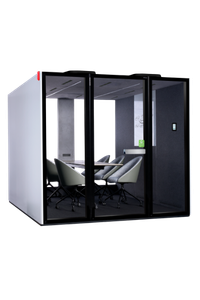

You’re inside an office phone booth, discussing a confidential project with a client.
The door is closed. The office outside is busy. You can still hear a faint sound of people moving around.
Then a question crosses your mind:
Can people outside actually hear what I’m saying?
It’s a reasonable concern, especially when office phone booths and privacy pods are used for client calls, interviews, financial discussions and other conversations that require discretion.
The answer is more interesting than a simple yes or no.
A well-designed acoustic office phone booth can significantly reduce the speech transmitted to the surrounding workplace. However, whether someone outside can understand the conversation depends on several factors.
Understanding these factors can help businesses choose an office phone booth based on measurable performance rather than marketing promises.
Can People Hear Conversations Inside an Office Phone Booth?
Yes, speech may still be audible outside an office phone booth, but that doesn’t necessarily mean the words are understandable.
This distinction is central to speech privacy.
Imagine someone speaking in a room next door. You may notice a faint voice without being able to identify individual words.
An acoustic phone booth aims to reduce speech transmission so conversations become less intrusive and more difficult to understand outside the enclosure.
The result depends on the booth’s acoustic construction, the speaker’s voice, the surrounding noise environment and the distance between the booth and nearby listeners.
In a busy open-plan office, background activity may help mask reduced speech coming from the booth.
In a very quiet office, that same reduced speech may be more noticeable.
This is why a phone booth should not be evaluated by whether it eliminates every audible sound.
A more practical question is whether it provides sufficient speech privacy for its intended use.
What Is Speech Privacy in an Office?
Speech privacy refers to how difficult it is for unintended listeners to understand a conversation.
It is different from simply reducing overall noise.
For example, an office privacy pod may reduce the volume of speech leaving the enclosure, making individual words harder to distinguish.
However, the degree of privacy experienced in a real workplace depends on both the enclosure and the surrounding environment.
Three concepts are useful when evaluating speech privacy.
1. Speech audibility
Can someone outside detect that a person is speaking?
Even when a booth provides substantial acoustic reduction, some speech may remain audible.
2. Speech intelligibility
Can someone outside understand the actual words?
A conversation may be audible without being intelligible.
For many everyday office applications, reducing speech intelligibility is more important than achieving complete silence.
3. Speech level reduction
How effectively does the enclosure reduce the speech transmitted from inside to outside?
This can be evaluated using standardized acoustic testing.
Understanding the difference between these concepts helps businesses interpret technical specifications more accurately.
What Does 30 dB Speech Level Reduction Actually Mean?
When researching office phone booths, you may encounter acoustic performance figures expressed in decibels.
For example, a manufacturer may report approximately 30 dB of speech level reduction.
But what does that mean in practice?
Speech level reduction describes the reduction in speech sound power measured using a defined testing method.
It is not simply a promise that every conversation will be 30 dB quieter at every location outside the booth.
Actual sound levels at a listener’s position depend on distance, room acoustics, surrounding noise and other conditions.
A pod with a strong measured speech level reduction result can help create a more private environment, but the rating alone cannot guarantee that every conversation will remain unintelligible.
For buyers, the important point is to understand what the rating measures and whether the result has been obtained using a relevant testing standard.
What is ISO 23351-1?
ISO 23351-1:2020 is an international standard used to measure the speech level reduction of furniture ensembles and enclosures.
It is particularly relevant to products such as office phone booths, working pods and meeting pods.
The laboratory method evaluates how much an enclosure reduces speech sound power by comparing measurements with and without the product.
The result is expressed as a single-number speech level reduction value, commonly identified as DS,A and measured in decibels.
This gives buyers a more consistent basis for comparing acoustic performance.
However, it is important to compare like with like.
A complete office pod tested under ISO 23351-1 should not be directly compared with a product reporting a different acoustic measurement without understanding the differences between the methods.
How Do Office Phone Booth Brands Compare?
Several established acoustic office pod manufacturers publish technical information to help buyers understand their products.
For example, Framery reports 30 dB speech level reduction for its One Compact office phone booth under ISO 23351-1.
Hushoffice publishes a 26.9 dB result for its Hushphone model in its European product specifications.
Mute reports speech level reduction values ranging from 27.2 to 30.5 dB for its Jetson S1, depending on configuration.
Winpod’s S Pod 3.0 Plus has a published speech level reduction rating of 30.1 dB.
ROOM also publishes an acoustic reduction figure for its office phone booth, but uses the NIC measurement method. That figure should not be treated as directly equivalent to ISO 23351-1 results.
These examples demonstrate why acoustic comparison requires more than looking at the largest number.
Buyers should confirm the testing method, model, configuration and supporting documentation before drawing conclusions.
Why Can You Still Hear Someone Inside a Privacy Pod?
Even a well-designed privacy pod may allow some speech to remain audible outside.
There are several reasons.
The surrounding office is unusually quiet
In a quiet workplace, even relatively low-level sounds may be noticeable.
In a busier environment, background noise may mask some of the speech transmitted through the enclosure.
Someone is speaking loudly
A person presenting enthusiastically during a video call may speak more loudly than someone having a normal conversation.
The level and character of the original speech can affect what listeners notice outside.
Someone is standing close to the booth
A listener standing immediately beside an enclosure may experience a different sound environment from someone several metres away.
Placement and surrounding room acoustics matter.
The door is not fully closed
Door seals and proper closure are important elements of acoustic enclosure performance.
An improperly closed door or damaged seal may reduce the booth’s effectiveness.
The booth has different acoustic performance characteristics
Not every office phone booth is designed or tested to the same standard.
Differences in construction, glazing, ventilation openings and assembly can influence speech transmission.
Does an Office Phone Booth Reduce Noise in Both Directions?
Office phone booths are commonly used to reduce speech transmitted from inside the enclosure to the surrounding workplace.
They may also reduce some external sounds experienced by the occupant.
However, these are different acoustic questions.
ISO 23351-1 primarily evaluates speech generated inside the enclosure and transmitted outward.
A strong speech level reduction rating should therefore not be interpreted as a complete measure of how much external office noise the occupant will hear.
If protection from surrounding distractions is particularly important, buyers should request additional information about the product’s internal acoustic environment.
Phone Booth vs. Privacy Pod: Is There a Difference?
The terms phone booth and privacy pod are often used interchangeably, but their emphasis can differ.
A phone booth is typically designed for individual phone calls, video meetings and short conversations.
A privacy pod is a broader term describing an enclosed workspace that provides greater separation from the surrounding environment.
A privacy pod may support calls, focused work or confidential discussions.
A working pod may offer additional desk space or features suited to longer individual work sessions.
A collaboration pod may accommodate several people.
These product categories overlap, so the most reliable way to compare them is by intended use, internal dimensions, acoustic performance and comfort.
Are Office Phone Booths Suitable for Confidential Conversations?
Office phone booths can provide useful privacy for many everyday workplace conversations.
Examples include:
- Client discussions
- Human resources conversations
- Financial planning meetings
- Job interviews
- Legal consultations
- Video conferences
- Sensitive internal project discussions
However, an acoustic booth should not automatically be treated as a secure environment for every type of confidential information.
Highly sensitive conversations may require additional measures, including appropriate room selection, information security practices and workplace policies.
Speech privacy is one component of confidentiality, not a complete guarantee.
How to Test Speech Privacy Before Buying an Office Phone Booth
Technical specifications provide a useful starting point, but a practical demonstration can help buyers understand how a booth performs in a realistic setting.
Step 1: Have someone speak inside the booth
Ask a colleague to speak at a normal conversational level with the door properly closed.
Step 2: Listen from different locations
Evaluate the sound immediately outside the booth, a few steps away and near the intended workstation locations.
Step 3: Focus on intelligibility
Ask whether you can understand individual words rather than simply whether you can hear a voice.
Step 4: Repeat the test with different speaking levels
Compare normal speech with a louder presentation-style voice.
Step 5: Consider the surrounding environment
A showroom demonstration may not represent the acoustics of your actual office.
For important procurement decisions, standardized acoustic test results should remain the main basis for technical comparison.
A simple listening test is useful for understanding the experience, but it is not a substitute for laboratory measurement.
What Else Should You Consider When Choosing an Acoustic Phone Booth?
Speech privacy is important, but a practical office phone booth must also support comfortable everyday use.
Ventilation: Enclosed spaces require suitable airflow for their expected occupancy and duration of use.
Lighting: Good lighting can make video calls and short work sessions more comfortable.
Ergonomics: Work surfaces, seating and internal dimensions should match the intended activities.
Accessibility: Buyers should consider access requirements and whether suitable alternatives are available for all employees.
Installation: The pod must be installed according to manufacturer instructions and applicable local requirements.
Maintenance: Door seals, ventilation components and other parts may require periodic inspection.
A booth that performs well acoustically but is uncomfortable or difficult to maintain may not meet the needs of its users.
Why Speech Privacy Matters in Modern Offices
Open-plan offices support interaction, but not every conversation belongs in a shared environment.
Employees frequently move between individual tasks, video calls, informal discussions and activities requiring discretion.
Office phone booths and privacy pods can help provide additional choices without requiring every conversation to occupy a conventional meeting room.
The objective is not to eliminate communication from the workplace.
It is to provide appropriate environments for different types of communication.
When selected and positioned thoughtfully, acoustic office pods can become part of a broader workplace strategy that balances collaboration, concentration and privacy.
Frequently Asked Questions
Can people outside hear you in an office phone booth?
Some speech may remain audible. Whether the words can be understood depends on acoustic performance, speaking volume, background noise, distance and other conditions.
Are office phone booths completely silent?
No. Acoustic office phone booths are designed to reduce speech transmission, not eliminate every sound.
Is 30 dB speech level reduction good for an office phone booth?
A result around 30 dB under ISO 23351-1 represents substantial measured speech level reduction. Actual speech privacy still depends on the installation environment and use conditions.
What is the difference between speech privacy and sound absorption?
Speech privacy concerns whether unintended listeners can understand conversations. Sound absorption concerns how materials absorb sound energy and influence the acoustic environment.
Does ISO 23351-1 measure sound coming into a pod?
The laboratory method primarily measures the reduction of speech generated inside an enclosure and transmitted outward. It should not be treated as a complete measurement of external noise entering the pod.
Can a privacy pod be used for confidential meetings?
It may be suitable for many everyday confidential discussions, but the required privacy level should be assessed according to the sensitivity of the information.
What should I compare when choosing between acoustic office pod brands?
Review model-specific acoustic test results, testing methods, ventilation, ergonomics, installation requirements, safety documentation, warranty and after-sales support.
Final Thoughts
So, can people hear you inside an office phone booth?
Sometimes, yes.
But hearing a faint voice and understanding a private conversation are two very different things.
The purpose of a well-designed acoustic phone booth is to reduce speech transmission and provide a more suitable environment for conversations within a busy workplace.
For businesses comparing office phone booths and privacy pods, understanding speech level reduction and ISO 23351-1 is a more reliable starting point than relying on broad acoustic marketing claims.
The right question isn’t whether an office phone booth eliminates every sound.
It’s whether the enclosure provides the level of speech privacy your workplace actually needs.